
Quick Answer: How to Scale Meta Ads Safely
To scale Meta Ads from ₹1,000 to ₹50,000/day without collapsing your ROAS, you must abandon erratic 100%+ budget increases that trigger the dreaded Learning Phase Reset. Scale using a dual approach: Vertical Scaling (bumping campaign budgets by no more than 15%–20% every 48 hours to preserve auction equilibrium) and Horizontal Scaling (launching distinct creative angles into separate Advantage+ containers or Cost-Cap bid campaigns). High-spend scaling is an inventory-diversification challenge, not a budget-setting button.
The Anatomy of a Failed Scale: Why ROAS Drops
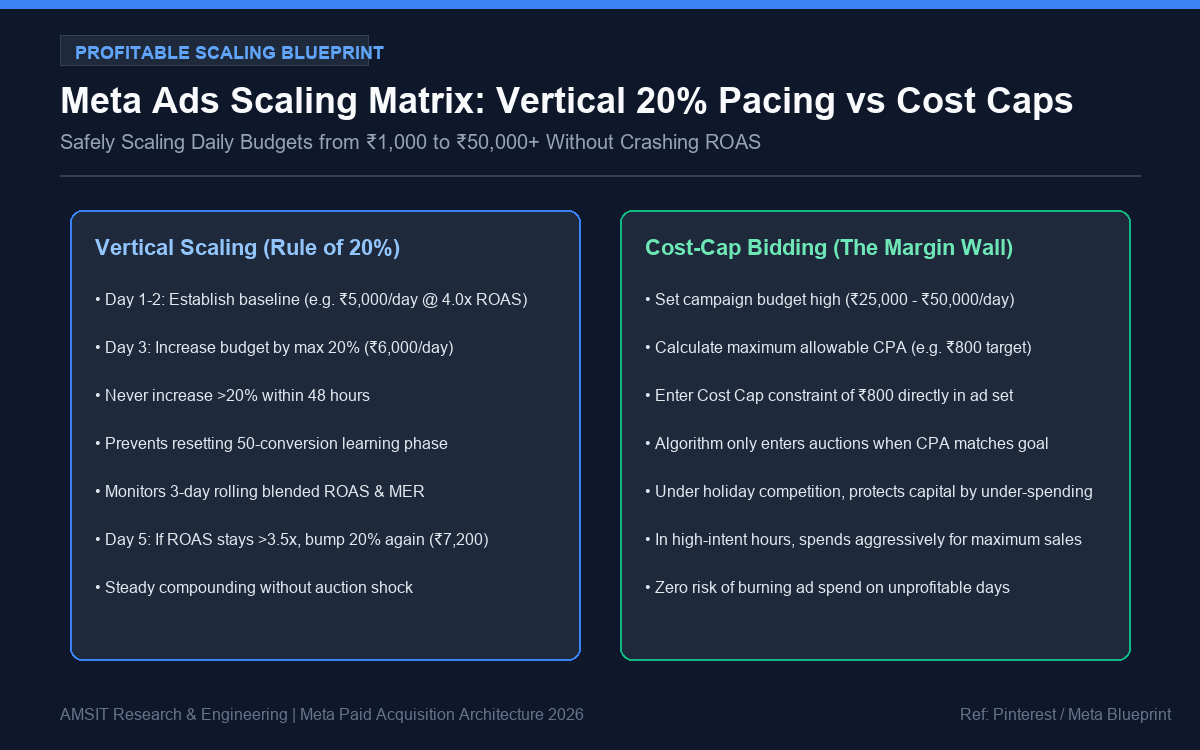
Visual Diagram: AMSIT Growth Scaling Blueprint
Almost every media buyer has experienced this frustrating cycle: An ad set produces a brilliant 4.5x ROAS at ₹1,500/day. Excited by the profit margin, the marketer doubles the budget to ₹3,000/day, and within 24 hours, the ROAS drops to 1.1x.
Why does this happen? When an ad set operates at low spend, Meta selects only the “lowest-hanging fruit”—users with the highest immediate purchase propensity. When you double spend overnight:
- The algorithm enters an aggressive exploratory phase, entering wider, higher-cost auction pools.
- The 50-conversion rolling learning window recalibrates.
- Single winning creative assets suffer rapid impression frequency burnout on the core audience.
The 4 Proven Meta Ads Scaling Frameworks
1. Vertical Scaling: The Rule of 20%
Vertical scaling involves increasing the daily budget of an existing, stabilized Campaign Budget Optimization (CBO) or Ad Set.
- Never increase budgets by more than 15% to 20% once every 48 to 72 hours.
- Always allow the algorithm to digest the new capital allocation across 2 complete midnight delivery cycles.
- If 3-day blended ROAS stays above your target KPI (e.g., 3.0x), execute the next 20% bump.
2. Horizontal Scaling: Creative Angle Diversification
Vertical scaling hits a ceiling when your winning ads cannot absorb more capital without CPM inflation. Horizontal scaling circumvents this by introducing brand new avatars and problem frameworks into parallel campaigns:
| Angle | Customer Pain Point / Trigger | Creative Format |
|---|---|---|
| Angle A: Frustration / Problem | “Tired of web hosts crashing during festival flash sales?” | UGC Selfie Video / Screen Demonstration |
| Angle B: Direct Comparison | “Why developers are leaving GoDaddy for LiteSpeed NVMe.” | Side-by-side static checklist graphic |
| Angle C: Financial Logic / ROI | “Cut AWS cloud hosting overhead by 65% with unmetered VPS.” | Calculator screenshot / Founder whiteboard |
3. Bid-Cap & Cost-Cap Scaling (The Wall of Safety)
At ₹20,000+/day, standard “Lowest Cost” auto-bidding becomes risky. If the market experiences sudden holiday competition (e.g., Diwali or Black Friday), Meta will exhaust your entire daily budget regardless of whether your ROAS goals are met.
Implement Cost-Cap Bidding:
- Calculate your Break-Even Cost Per Acquisition (CPA). If product price is ₹2,000 and margin is ₹1,200, your maximum allowable CPA is ₹1,200.
- Set a Cost-Cap campaign with a target CPA of ₹800.
- Set the daily budget to ₹50,000.
- The Result: Meta will only enter auctions where the estimated probability of conversion meets your ₹800 CPA threshold. If viable conversions are available, it spends aggressively. If the auction is overly competitive, it will protect your capital and under-spend.
4. The Surge Scaling Method for Peak Days
On high-traffic dates (Payday weekends, product launch days, festive promotions), utilize the Surge Method: Increase your winning CBO budget by 50% at 6:00 AM. Monitor hourly performance in Google Analytics 4 or your backend CRM. If ROAS remains outstanding by 4:00 PM, maintain the budget until 11:30 PM, then return it to baseline before midnight.
Key Metrics to Monitor During High-Volume Scaling
- MER (Marketing Efficiency Ratio): Total Revenue / Total Ad Spend across all channels. Keep MER above 3.5x.
- Outbound Click-Through Rate (CTR): Must remain above 1.5%. A dropping CTR indicates creative fatigue before ROAS drops.
- First-Time Impression Ratio: Ensure at least 80% of impressions inside scaling ad sets are unique viewers.
For sustainable lead gen scaling strategies, examine our playbook on Meta Ads for Local Business Lead Generation.
Frequently Asked Questions
When is an ad account officially ready to scale past ₹10,000/day?
When you have: (1) A server-side Conversions API integration with an 8.5+ match score, (2) A minimum of 3 completely distinct creative formats converting consistently, and (3) Proven inventory supply chain capacity that can handle 3x order volume without fulfillment delays.
Should I scale winning ads inside their original ad set or duplicate them?
Never duplicate an ad set merely to scale it—duplicating divides machine learning data and introduces self-competition. Scale the original ad set vertically or use horizontal creative testing into an ASC umbrella.
