
If you are an entrepreneur, retailer, or manufacturer wondering how to start ecommerce website in india, the opportunities have never been more lucrative. India’s digital retail landscape is expanding exponentially, driven by widespread 5G connectivity, the national Unified Payments Interface (UPI) infrastructure, and consumers eager to buy directly from authentic homegrown Direct-to-Consumer (D2C) brands.
Quick Answer (At a Glance):
To start an e-commerce website in India in 2026, you need four core components: a legal entity with GST registration, a dedicated self-hosted platform (WooCommerce or Shopify), an integrated Indian payment gateway supporting UPI (Razorpay, Cashfree, or PhonePe), and a domestic courier aggregator (Delhivery or Shiprocket). Launching an initial functional store typically costs between ₹15,000 to ₹40,000.
In this guide, the engineering team at AMSIT shares our practical, step-by-step blueprint compiled from deploying dozens of successful online stores across West Bengal and nationwide.
Table of Contents
- 1. Select Your Niche & Sourcing Strategy
- 2. Legal Formalities, Company Registration & GST
- 3. Choosing the Right Platform: WooCommerce vs Shopify in India
- 4. Secure Your Domain Name & High-Speed Indian Hosting
- 5. Integrating Indian Payment Gateways (UPI, Cards, NetBanking)
- 6. Setting Up Domestic Shipping & Handling Cash on Delivery (COD)
- 7. Designing High-Converting Store Layouts & Product Pages
- 8. Organic SEO, Meta Ads & WhatsApp Marketing
- 9. Setting Up Conversion Tracking (GA4 & Meta Pixel)
- Complete Indian eCommerce Cost Breakdown Table (2026)
- Frequently Asked Questions (FAQ)
1. Select Your Niche & Sourcing Strategy
The biggest trap new sellers fall into is trying to be “Amazon” by selling everything to everybody. Sustainable Indian D2C brands succeed by mastering a hyper-focused niche: handloom apparel, regional handicrafts, organic health foods, specialty cosmetics, or industrial hardware.
Ensure your product has a healthy gross margin of at least 50% to 60%. With domestic shipping taking ₹50–₹90 per parcel and customer acquisition costs rising, thin 15% margins will struggle under advertising spend.
2. Legal Formalities, Company Registration & GST
A frequent question asked by beginners searching how to start ecommerce website in india is whether GST registration is mandatory. The answer is yes: under Section 24 of the Central Goods and Services Tax (CGST) Act, any business engaged in inter-state e-commerce supply must register for GST regardless of turnover.
- Business Structure: Start with a Sole Proprietorship (using your PAN card and MSME / Udyam Certificate) or register a Private Limited Company if raising capital.
- Current Account: Open a bank current account in your business trade name to facilitate seamless payment gateway onboarding.
3. Choosing the Right Platform: WooCommerce vs Shopify in India
When determining how to start ecommerce website in india, your platform choice dictates ongoing expenses and operational independence:
| Metric | WooCommerce (WordPress) | Shopify |
|---|---|---|
| Monthly Platform Fee | ₹0 (Open Source) | ~₹1,999 to ₹7,499 / month |
| Transaction Surcharge | 0% additional fee | Up to 2% unless using Shopify Payments |
| Data Ownership | 100% full database control | Hosted proprietary cloud |
| Customizability | Unlimited custom PHP & APIs | Restricted to Liquid templates |
For most Indian small businesses, WooCommerce is the most cost-effective solution because you avoid compounding monthly subscription overheads. Learn more about our custom WordPress and WooCommerce development services.
4. Secure Your Domain Name & High-Speed Indian Hosting
Choose a clean, memorable .in or .com domain. For local Indian buyers, a .in domain builds immediate geographic trust. Host your platform on servers physically located in India (Mumbai, Bengaluru, or Delhi) or fronted by Cloudflare CDN to ensure page loads under 1.5 seconds.
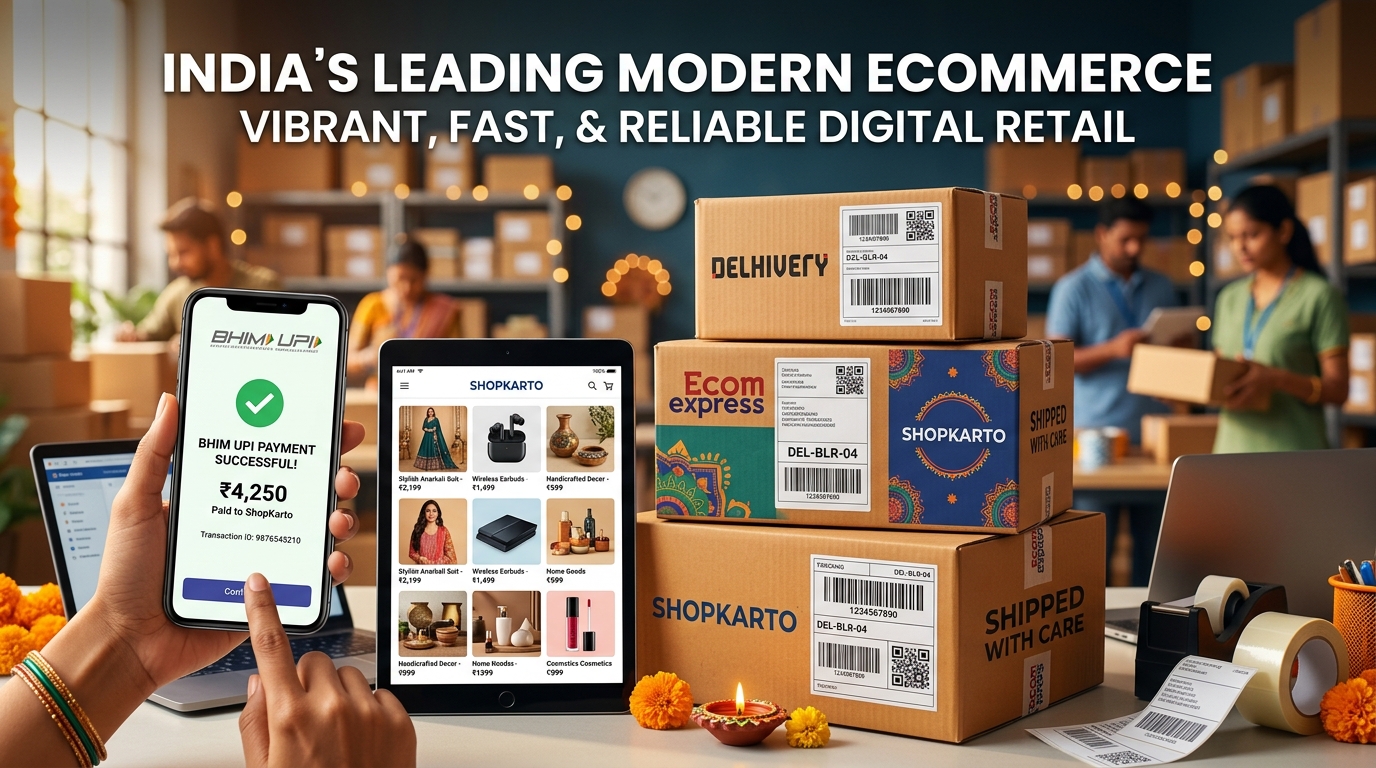
5. Integrating Indian Payment Gateways (UPI, Cards, NetBanking)
In India, UPI accounts for over 75% of online retail transaction volume. Failing to offer a seamless UPI payment gateway destroys conversion rates.
- Razorpay: The industry standard for Indian e-commerce, offering one-click UPI intent flows, cards, and net banking with standard 2% processing fees.
- Cashfree Payments: Renowned for lower drop-off rates and instant refunds on customer cancellations.
- PhonePe Payment Gateway: Highly popular among emerging D2C brands looking for competitive merchant transaction charges.
6. Setting Up Domestic Shipping & Handling Cash on Delivery (COD)
Shipping logistics make or break e-commerce operations in India. Rather than negotiating contracts with individual courier firms, integrate with logistics aggregators such as Delhivery or Shiprocket.
Managing COD and RTO (Return to Origin): While Cash on Delivery attracts up to 60% of tier-2 and tier-3 shoppers, RTO rates can hit 20%–30%. To protect profits, implement OTP verification on COD orders or offer a ₹50 discount for instant UPI prepaid payments.
7. Designing High-Converting Store Layouts & Product Pages
Your product pages must eliminate all buyer hesitation. Follow international UI standards outlined by the W3C Web Standards:
- Crisp, multi-angle product photography with zoom functionality.
- Transparent pricing showing GST inclusion and estimated delivery dates.
- Prominent, sticky “Add to Cart” and “Buy Now via UPI” buttons on mobile screens.
- Customer reviews, unboxing videos, and verified buyer badges.
8. Organic SEO, Meta Ads & WhatsApp Marketing
Once live, customer acquisition begins. A balanced growth engine utilizes two complementary channels:
- Organic Search & Local SEO: Optimize product title tags, schema markup, and publish helpful buyer guides to capture high-intent Google searchers. Check out our SEO and SEM agency services.
- WhatsApp Commerce: Integrate automated WhatsApp notifications for order confirmations, abandoned cart recovery, and live dispatch tracking.
9. Setting Up Conversion Tracking (GA4 & Meta Pixel)
Never run marketing blind. Install Google Analytics 4 (GA4) with e-commerce purchase event tracking, and verify your Meta Conversion API (CAPI) through your server to bypass iOS ad-tracking limitations.
Complete Indian eCommerce Cost Breakdown Table (2026)
| Component | Estimated Cost (INR) | Payment Frequency |
|---|---|---|
| Domain Name (.in / .com) | ₹600 – ₹1,200 | Annual |
| High-Speed SSD Hosting | ₹3,000 – ₹7,000 | Annual |
| Custom Store Design & Development | ₹15,000 – ₹35,000 | One-time CapEx |
| Payment Gateway Integration | ₹0 setup (2% per transaction) | Per order |
| Initial Marketing & Ad Spend | ₹5,000 – ₹15,000 | Monthly test budget |
Frequently Asked Questions (FAQ)
Can I sell online in India without a GST number?
If you sell exclusively within your own state through your own independent website, certain threshold exemptions apply; however, all major payment gateways (Razorpay, Cashfree) and logistics providers (Shiprocket) require a valid GSTIN for merchant verification. Obtaining a GSTIN is free and strongly advised.
How long does it take to launch an e-commerce website?
A streamlined, professional WooCommerce store can be designed, configured, and tested with live payment gateways within 10 to 18 business days when collaborating with an experienced agency.
Which is better for Indian sellers: selling on Amazon or owning a website?
Both serve vital functions. Marketplaces like Amazon offer immediate buyer traffic but charge 15%–35% in commissions and control customer data. Owning your standalone website builds brand equity, captures direct customer data, and yields higher long-term profitability.
Need expert guidance to launch your online store?
Speak with our e-commerce engineers. Contact AMSIT today for a tailored technical strategy and quote.
